I spent weeks building The Developer's AI Productivity Blueprint with my team. I ran the launch using the same principles I used 10 years ago for my two Ruby books, and while those launches went well, this one was a… complete failure.
What went wrong? Is it because times have changed? Or did I just make a massive mistake?
The Idea
AI is changing what "productive developer" means, very fast. The Blueprint we created is a practical course on working with AI while remaining a real engineer, not just an operator, by focusing on workflows, methodology, automation, and code reviews.
It's not vibe-coding or pure theory, but concrete techniques I use on real client work every day. I wanted to teach it the way I wish someone had taught me.
State at Launch
Here's the honest inventory of what I had on launch day:
- An email list of about 2,700 developers, built years ago around my Ruby and Rails content. To be honest, when I revived Devmystify last year, that list was above 3,000. So we've lost quite a few people, that didn't get replaced. That was to be expected, and honestly better than I hoped.
- A finished course at $199 with a brand-new sales page.
- Zero reviews.
- No content engine. No YouTube, no socials for Devmystify, no lead magnet, no nurture sequence. Just the mailing list.
The Process I Used
I used the textbook launch playbook: Announcement, then a warm-up sequence with tiered discounts: my earliest supporters got 50% off, past buyers got 40%, then the whole list got a launch price with a real deadline. Final-day email, final-hours email, countdown timer on the page. Everything that's supposed to happen, executed on schedule.
What Happened
The emails performed fine on paper. Open rates between 32% and 48% depending on the email, honestly better than I expected from a list this cold. Click rates in the double digits, which looked amazing until I dug in and realized a big chunk of the clicks might be bots. Mail clients may be clicking links in emails to verify them, because when your click-to-open ratio looks too good to be true, it probably is. Especially when your conversion rate is terrible.
By the end of the launch week, I had a whopping… 3 sales.
I refreshed my kit.com dashboard every morning… watching it not move at all. If you've launched anything, you know that exact feeling.
Now for the number… those 3 sales made $417, which is great for a product I should have validated better.
Where It Went Wrong… Maybe
So now I'm going to make up some assumptions and come up with some theories about what I did wrong: three things specifically, and "the product is bad" isn't one of them. At least, I hope it isn't, which so far, has been reinforced by the feedback I got from early adopters.
1. Wrong audience, not small audience. My 2,700 subscribers signed up for Ruby and Rails content years ago. They didn't join for an AI course. Audience size is not audience fit, and I confused the two. I assumed everyone else was going through the same AI adaptability issues as me, and might want some tips… which they can likely get from Claude itself directly. Which I still don't think is enough, since you don't know what you don't know, and if you don't prompt the right questions, you'll never find those tips.
2. Zero social proof on a $199 decision. Every visitor saw an empty reviews box. That box quietly tells people "nobody has bought this." For a considered purchase, that's not great. But even with the review of one of the early buyers for the last day reminder, things didn't improve.
3. No engine, just a blast. I pointed a cold list at a page and hoped. Anyone who wasn't ready to buy that week had no reason to stick around, so they left and that was it.
I wasn't expecting too much honestly… but I was still expecting more than what I got. 100% my fault, and still a great lesson to learn from.
Plus, a failed launch doesn't mean that the product is a failure. It's there, it's available, and I can promote it going forward while I work on the next one. I'm also going to experiment with paid ads, something I've never really done before. I'll keep you updated on how that goes.
And that's not all.
Why I'm Not Giving Up
Because a developer I'd never met went through the course and left a genuine five-star review:
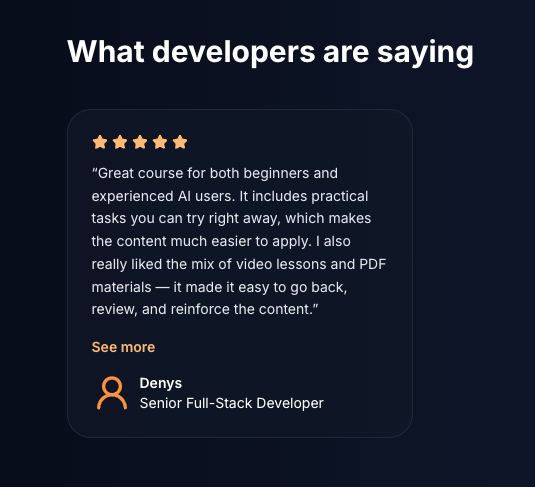
Which means he found value in it. If that first review had been 1-star instead, I might have deleted the course or completely remade it. I'm not someone who likes selling crap, I want people to get way more value than what they put in. That's always been my philosophy, be it for consulting or product creation.
So the plan is to build the missing link to get more sales:
- Running small ad tests now that the page has proof on it.
- Publishing short and long form content on new Devmystify channels: on YouTube, Instagram, and TikTok. This should help me build an audience that actually signed up for this topic. I've seen people talk about social media as a great source of leads, and I'm going to put it to the test.
What's Next for Devmystify
AI changed the game for developers, and the way I see it you have two moves.
Move one: get so good with AI that you're the developer your team can't replace. That's the Blueprint , and it's live today. But even then, an uninformed decision by the executive team can still leave you stranded, in a job market that seems really, really tough right now. Which leads me to the second move, something I've personally been working on: moving away from solely relying on software development as my source of revenue, just in case.
And that's move two: build something of your own before you need it. Start now, on the side, before it's too late.
That's the flagship course I'm building next, which will combine the 3 courses that were live on the site. Freelance to Freedom, Master Digital Products, and the SaaS Blueprint will now become one: The Independent Developer.
Because fundamentally, a SaaS or a digital product are just products, which need an audience to work, something you should build before you write a single line of code or text. As for Freelance to Freedom, I will lightly cover it, but again, I do not recommend freelancing in the traditional way anymore. Productized services are the way to go instead.
This will be a complete guide for developers who want to go from employee to business owner because they're worried about where AI is taking their jobs, or aren't enjoying the new era of software development.
And honestly, now is the best window there's ever been to jump in: the models are still affordable, which might not last. Companies are already starting to limit AI usage internally after all. So if you want to build something with AI assistance, the time is now, while the door is wide open.
The course will cover building an online presence, before monetizing it. It will also touch on pivoting into a whole new field and building a business on that if you dislike the new normal.
The Independent Developer launches first as a founding cohort. The waitlist is open on the courses page .