Picking a programming language to learn is like picking a starter Pokémon from Professor Oak. You go back and forth, weighing the trade-offs and asking yourself, "Did I make the right choice?" So today, we will look into last year's trends so that you can pick a language not just on a hunch, but by statistics.
The picture below is from GitHub’s Octoverse
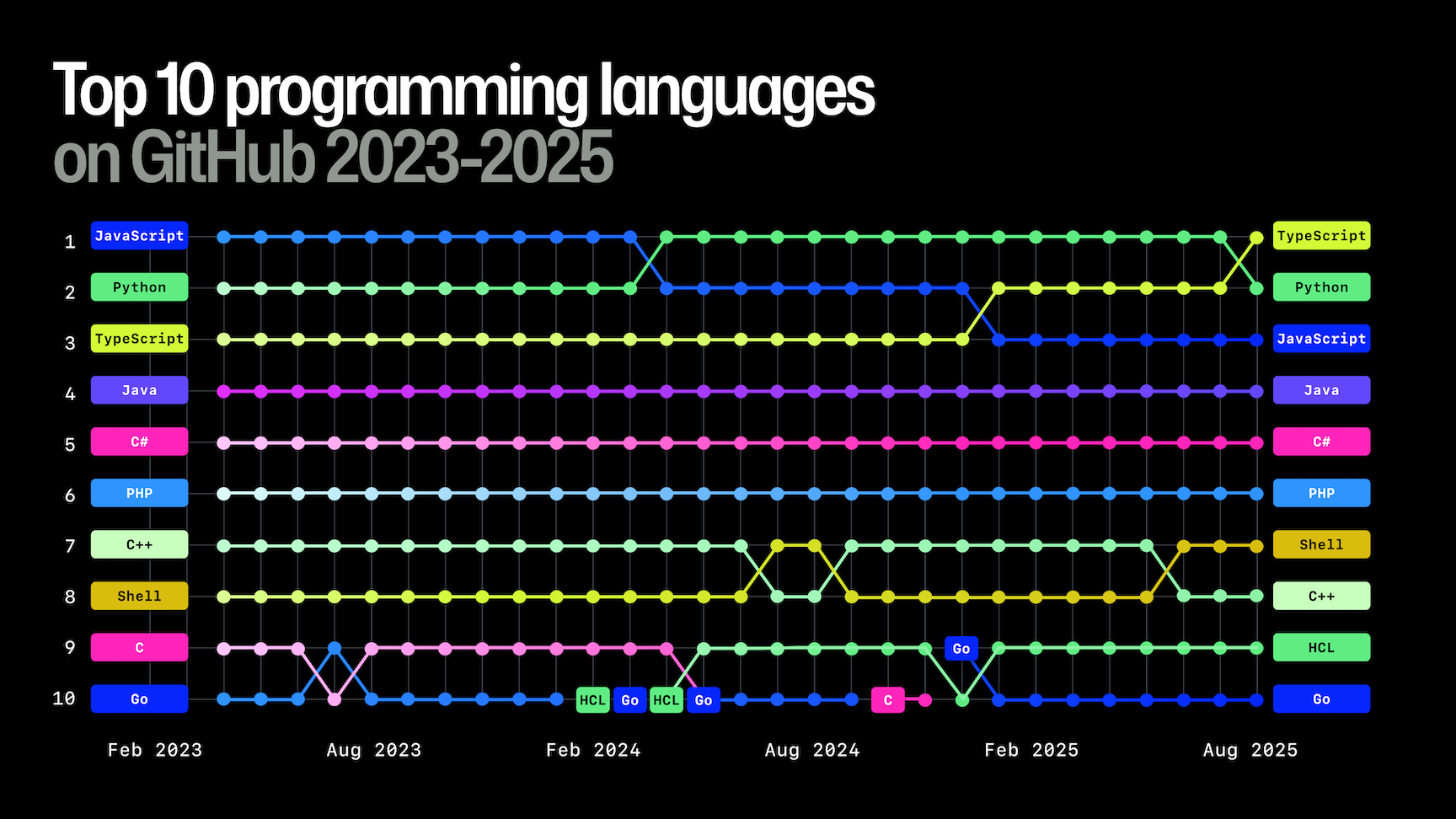
As you can see, we’ve got 10 programming languages, and the ranking is based on GitHub repositories, considering it's the largest platform for storing code projects, we are off to a good start, right?
I will also use data from Cloudflare Radar as a backup advocate for these stats. Let's get started.
10. Go
The cute blue mascot stays at number 10 for the 3rd year in a row. Go is a compiled language known for its simple, C-like syntax (but easier) and concurrency. Right now, Go is at version 1.25, and you can check the recap of the updates from GopherCon UK here .
You might want to learn Go if you want to create backend APIs. The language itself is powerful and capable of low-level programming. While it has no OOP, it uses structs and interfaces, and its "channels" make concurrency programming much easier. Plus, according to Cloudflare Radar, Go is the most popular choice for API Client Languages.
9. HCL
Ok, I'm not gonna lie, I wasn't familiar with this one either. So what is HCL? It stands for HashiCorp Configuration Language. Simply put, it is a language where you write configurations, similar to YAML. HCL is mostly used in infrastructure departments or in the world of IaC (Infrastructure as Code), specifically with HashiCorp tools like Terraform, Packer, etc. You might want to learn HCL if you want to work in DevOps, Software Architecture, or Infrastructure-related fields.
8. C++
C++ is the programming language that developed further on C by adding OOP into the mix. It is a compiled language, fast, capable of high and low-level programming and it offers better memory management tools than C. C++ is mostly used in performance-focused applications and embedded IoT devices. Also, if you want to do game development, C++ is one of your best choices to learn because Unreal Engine is a feature-packed game engine built on it. And just so you know, Node.js is written in C++.
Even though C++ has been around for decades, the language itself updates every 3 years. The last one was C++23 (2023), so the new update is coming this year.
7. Shell
Not much to talk about here; it's the language that we use all the time to make our lives as developers easier. If you're new to programming or haven't had time to learn shell scripting, you should definitely pick this up. It handles file management, automation, system administration, and remote access. On Unix OS, you can learn it once and use it on macOS and Linux (using zsh or bash), but on Windows PowerShell, it's a whole new world, so just keep that in mind.
6. PHP
PHP: the liveliest "dead" programming language ever. Every year, PHP gets at least one post claiming it's dead, but it never is. It stays consistently at rank #6. Cloudflare reports that 45% of the top 5000 domains use PHP, and 47% use WordPress as a CMS. Currently, PHP is at version 8.5, released in November 2025. It's a modern programming language now, with well-known frameworks such as Laravel that can work with Vue and React to create full-stack applications.
5. C#
C# is an OOP-heavy language with syntax similar to Java. It's powerful and has its own massive ecosystem. C# and .NET come as a package. Back then, .NET was really hard to work with; you needed to learn .NET Core for web apps, .NET Framework for desktop apps, and Xamarin for mobile. But to this day, .NET has improved a lot and unified everything into just ".NET". The well-known frameworks for C# are ASP.NET Core and .NET MAUI. If you learn C#, you will get into the .NET ecosystem and learn programming architectures like MVC automatically.
4. Java
The enterprise powerhouse: Java. It's the standard for large company software, boasting well-known frameworks like Spring Boot. Java is an OOP-heavy language like C# (which was actually built based on Java). Even though it's a really old language, it is not outdated. The language itself updates every 6 months; right now it's at JDK 25, which was released last September. Statistically speaking, Java is ranked #3 in the most popular API client choices on Cloudflare Radar. Learn this if you want a mature language and frameworks that large companies rely on.
3. JavaScript
In the GitHub ranking, it used to be the number one most popular language, but regardless of rank, every website on the internet uses JavaScript one way or another. It's easy to learn, and web dev is extremely popular. JavaScript is the core of ECMAScript, which is the standard for browser vendors to develop features. Its ecosystem features three major runtimes: Node.js (the big brother of the industry), Deno (another V8 engine runtime supporting TypeScript natively, written in Rust), and Bun (a JavaScriptCore engine written in Zig).
2. Python
Before GitHub Octoverse concluded, Python looked like it would be number one on the list, but it fell short just before the event finished. In this AI era, Python is the default language. You have Pandas, Scikit, TensorFlow, and many more libraries and frameworks to work with AI. It has simple syntax, almost like speaking English, and a huge community.
Some say Python is slow, but recently, the Python 3.14 update unlocked "Free-threaded mode" to make the single-thread behavior disappear, which means Python is faster now. It also has well-known frameworks like Django and FastAPI. You can't go wrong if you want to learn this language. You can do pretty much everything from software development to Data/AI with it.
1. TypeScript
The upgraded version of JavaScript: TypeScript. Last year, TypeScript announced a move to make itself 10x faster by being rewritten in Go , solving its problem of slowness during compilation.
It is a well-known language because it stems from JavaScript (the former rank 1), but now it has taken over because of AI coding. Long story short: Generative AI has a lot of data about JavaScript coding but often makes mistakes. By using the type safety of TypeScript, AI becomes more accurate that's why it's becoming more popular in AI-assisted coding. The ecosystem is huge, with frameworks like Next.js (a fullstack framework with Vercel deployment support), React and Vue as standard frontend libraries, and many more JavaScript frameworks, I've lost count already!
Conclusion
Picking what to learn can be annoying because we want to pick the "right" one, but the truth is, there is no right one. You could pick anything, become good at it, and make money or find a job. The trade-off is simple: if you pick a popular language, you get more opportunities but also more rivals. If you pick a less popular language, you get the opposite.
The thing is, a programming language is just a tool. The best skills you can have as a developer are problem-solving and the ability to learn. So apart from mastering the tool, please practice these as well.
So, what language do you want to learn this year? Zig? Rust? Or will you master a current main language? I'm happy to hear your thoughts!
